
Zero-Click Searches are Here
For years, building an online presence followed a predictable formula. You ranked on Google, people clicked your website, and if everything looked decent, you had a chance to turn that visitor into a customer.
That system worked because attention flowed in one direction. Search ? click ? decision.
But that sequence is breaking down.
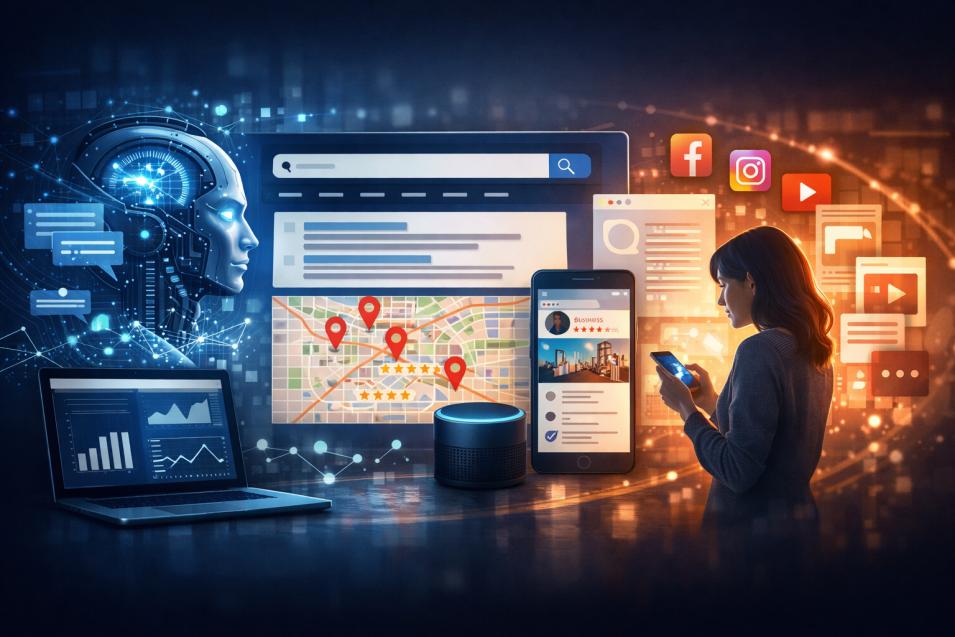
Today, people are getting answers before they ever reach your site. Search results are filled with AI-generated summaries, map packs dominate local intent, and platforms increasingly keep users inside their own ecosystem. Whether it’s a quick answer surfaced by OpenAI tools or a recommendation pulled directly into a search result, the user journey is being compressed.
The decision is happening earlier — often invisibly.
And that changes everything.
The Moment Your Customer Decides — It’s Not On Your Website Anymore
Think about how people actually search now.
Someone types “best electrician near me,” and within seconds they see:
- A map with top-rated businesses
- Reviews, ratings, and photos
- A quick snapshot of credibility
They don’t need to click ten websites anymore. In many cases, they don’t click anything at all.
The same thing happens with informational searches. Ask a question about pricing, timelines, or materials, and you’re likely to see a summarized answer immediately. The user gets clarity without needing to explore further.
By the time someone finally lands on your website, they’re not exploring — they’re confirming a decision they’ve already started making.
That means your website is no longer the start of the journey.
It’s the final checkpoint.
Your Website’s New Role: Confirmation, Not Discovery
This shift forces a fundamental change in how websites should be built.
In the past, a website needed to educate. It walked visitors through who you are, what you do, and why it matters.
Now, your website has a much more urgent job: it needs to remove doubt instantly.
The visitor arrives with a question already forming in their mind:
“Is this the one I’m going with?”
Everything on your site should answer that question without hesitation.
That includes the headline they see first, the proof you provide within seconds, and how quickly they can take action. If any part of that process introduces friction — confusion, delay, uncertainty — you lose them.
Not because your service isn’t good, but because someone else made it easier to say yes.
The Illusion of Traffic (And Why It’s Becoming Less Valuable)
A lot of businesses still measure success by traffic. More visitors means more opportunity, right?
Not anymore.
Traffic without conversion is becoming one of the most misleading metrics in digital marketing. You can have hundreds or even thousands of visitors and still struggle to generate consistent leads if your site isn’t built to close decisions quickly.
At the same time, the platforms driving that traffic are becoming less reliable. Algorithms shift. Ad costs rise. Organic reach fluctuates.
You don’t control any of that.
What you can control is what happens when someone lands on your site — and more importantly, whether you capture that opportunity before they leave.
Because in today’s environment, you often only get one chance.
Why Ownership Matters More Than Ever
One of the biggest risks businesses face right now is dependence.
If your leads come entirely from platforms like Meta, Google, or third-party directories, you’re operating on borrowed ground. Those platforms can change the rules at any time — and they often do.
The businesses that will thrive moving forward are the ones that build systems they own.
That means capturing information directly:
- Names
- Emails
- Phone numbers
- Project details
It’s not just about generating a lead in the moment. It’s about creating a pipeline you can return to, follow up with, and grow over time.
Because while traffic can disappear overnight, a database of real potential customers doesn’t.
The Quiet Power of First Impressions
There’s a misconception that users carefully evaluate websites.
They don’t.
Most decisions happen in seconds, driven by instinct more than logic. People are scanning for signals — visual, emotional, and social — that tell them whether they trust you.
If your site looks outdated, loads slowly, or feels generic, it creates hesitation. And hesitation is enough to send someone elsewhere.
On the other hand, when a website feels clear, modern, and confident, it removes friction immediately. The user doesn’t have to think as much. They don’t have to search for reassurance.
They simply move forward.
That’s the difference between a site that gets “looked at” and one that actually produces results.
Becoming the Source Instead of the Destination
As AI-driven answers become more common, there’s another shift happening beneath the surface.
Websites are no longer just destinations — they’re becoming sources.
When platforms generate answers, they rely on structured, well-written content to do it. Businesses that provide clear, authoritative information are more likely to be included in those answers, even if the user never clicks through.
That might sound like a loss at first.
But it’s actually an opportunity.
Because being the source builds credibility at scale. It positions your business as the authority in your space, which influences decisions even when you’re not directly visible.
The key is to write content that reflects real-world questions. Not generic blog topics, but the exact things your customers are already asking:
- What does this cost?
- How long does it take?
- What should I expect?
When your content answers those questions clearly, it becomes valuable not just to users, but to the systems that deliver those answers.
The Rise of Instant Decisions
Attention spans didn’t just shrink — expectations changed.
People want clarity immediately. They want to know:
- Are you legitimate?
- Are you experienced?
- Can you solve their problem?
And they want those answers without digging.
This is why elements like reviews, photos, and real project examples matter more than ever. They communicate trust faster than paragraphs of text ever could.
It’s also why simplicity wins.
The more steps someone has to take, the more likely they are to stop. Every extra decision you force them to make — where to click, what to read, how to contact you — increases the chance they’ll leave.
The best-performing websites today feel almost effortless to use. Not because they’re basic, but because they remove everything that isn’t necessary.
Where Most Websites Fall Behind
Despite all of these changes, many websites still follow outdated patterns.
They try to say too much. They bury important information. They prioritize design trends over usability. And most importantly, they fail to guide the user toward a clear next step.
This creates a disconnect.
The business might be strong. The service might be excellent. But the website doesn’t reflect that reality in a way that users can immediately understand.
And in a fast-moving digital environment, that gap becomes expensive.
What the Future Actually Looks Like
The next phase of the internet isn’t about more features or more complexity.
It’s about alignment.
Websites will need to work seamlessly with:
- Search engines
- AI platforms
- Mobile behavior
- Real-time expectations
They’ll become less like static pages and more like responsive systems — adapting to how people search, how they think, and how they make decisions.
At the same time, the businesses that succeed won’t necessarily be the biggest or the loudest.
They’ll be the clearest.
A Different Way to Think About Your Website
Instead of asking:
“How do I get more people to visit my site?”
The better question is:
“What happens when they do?”
Because that moment — the few seconds after someone lands on your page — is where everything is decided.
Not in your rankings.
Not in your ads.
Not in your traffic reports.
But right there, in real time.
Final Thought
The internet didn’t remove opportunity.
It compressed it.
The businesses that adapt to that reality — that build trust faster, communicate more clearly, and capture attention more effectively — will have an advantage that compounds over time.
Everyone else will keep chasing clicks that matter less and less.